Posts

Showing posts with the label GeotechnicalEngineering

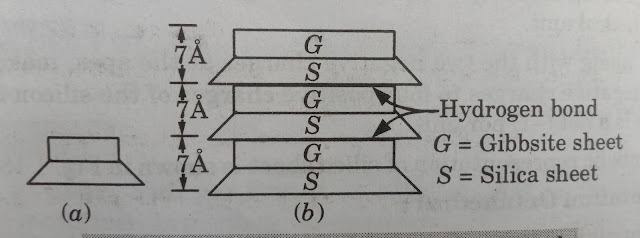
Kaolinite, illite, montmorilonite, How the clay minerals kaolinite, illite and montmorillonite are formed by schematic diagram.
Image
 Kaolinite:- Kaolinite is the most common minerals of the kaolinite group of clay minerals. Its basic structural unit consists of gibbsite  sheet with aluminium atoms at the center. It is joined to silica sheet through the unbalanced oxygen atoms at the apexes of silica sheet. The total thickness of the basic structural unit is about 7 angstrom. The basic structural unit of kaolinite minerals is symbolised as shown in figure. Kaolinite minerals The basic structural units of kaolinite minerals are joined together by hydrogen bond. It develops between the oxygen atoms of silica sheet and the hydroxyls of gibbsite sheet. Since the hydrogen bond is fairly strong, it is extremely difficult to separate the layers, and hence, kaolinite minerals is relatively stable. Moreover, water cannot penetrate through the layers of the structural units of kaolinite minerals. Kaolinite shows relatively little swell on wetting. China clay is almost pure Kaolinite. Montmorillonite Montmorillonite i...
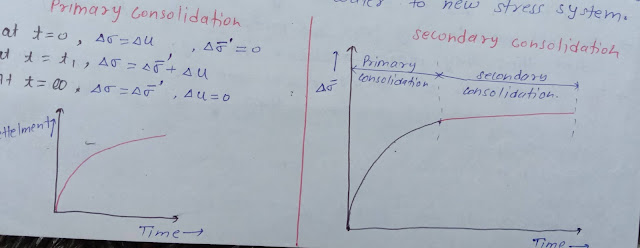
What is consolidation? , Primary consolidation, secondary consolidation

Image
  Consolidation:- The the compression of a saturated soil under static pressure is known as consolidation. It is occurs due to expulsion of water from the voids. The the soil particles shift from one position to other by rolling and sliding thus they attain a closer packing. The decrease in soil volume occurs not due to compression of solids or water but due to shifting of soil particles as water escapes. Consolidation can occurs due to one or more of the following factors. 1. Due to external static loads from the structure. 2. Due to self weight of soil such as recently placed fills. 3. Due to lowering of the ground water table. 4. Due to desiccation. Primary consolidation:- After initial consolidation further reduction in volume occurs due to the expulsion of water from the voids. When saturated soil is subjected to a load or pressure initially all the pressure is taken up by water as an excess pore water pressure. As water is almost incompressible as compared with soil solid par...

Total stress, pore water pressure, effective stress,Unit-2, Geotechnical engineering

Image
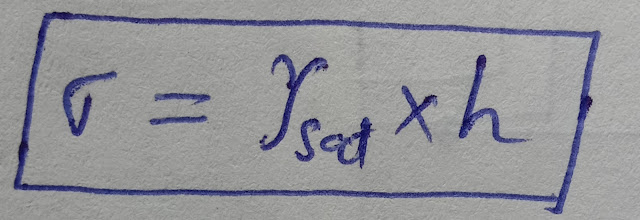
  Total stress:-   When a load is applied to soil, it is carried by the soil grains and the water in the pores. The total vertical stress acting at a point below the ground surface is due to the weight of every thing that lies above including soil water and surface loading. Vertical total stress at height  h, Total stress Total stress thus increasing with height and with unit weight. Pore water pressure:- Pore water pressure is the pressure due to pore water filling the voids of the soil. Thus Pore water pressure pore water pressure is also known as natural pressure or natural stress , because it can't resist shear stress. Effective stress: -  The effective stress at a point in the soil mass is equal to the total stress minus the pore water pressure. Thus Effective stress For saturated soil , it is obtained as  Effective stress             Gkgautam6036.blogspot.com

What is soil compaction? , What is compaction? , Factor affecting compaction

Image
  What is compaction ? Compaction means pressing the soil particles close to each other by mechanical method. During the compaction air is expelled from the void space in the soil mass. Compaction is the process of increasing the bulk density of soil for aggregate by driving out air. Soil compaction Increasin density Increases strength characteristics Increase load bearing capacity Increase effective stress Increase negative pore pressure Decrease undesirable settlement Decrease permeability  Decrease water seepage Decrease frost damage Decrease swelling and shrinkage Decrease erosion damage Factor affecting compaction:- 1. Water content:- With increase in water content compacted density increase up to a stage beyond which compacted density decrease. The maximum density achieved is called MDD and the corresponding water content is called OMC. At lower water contents then OMC soil particles are held by the force that prevents the development of diffused double layer leading to ...